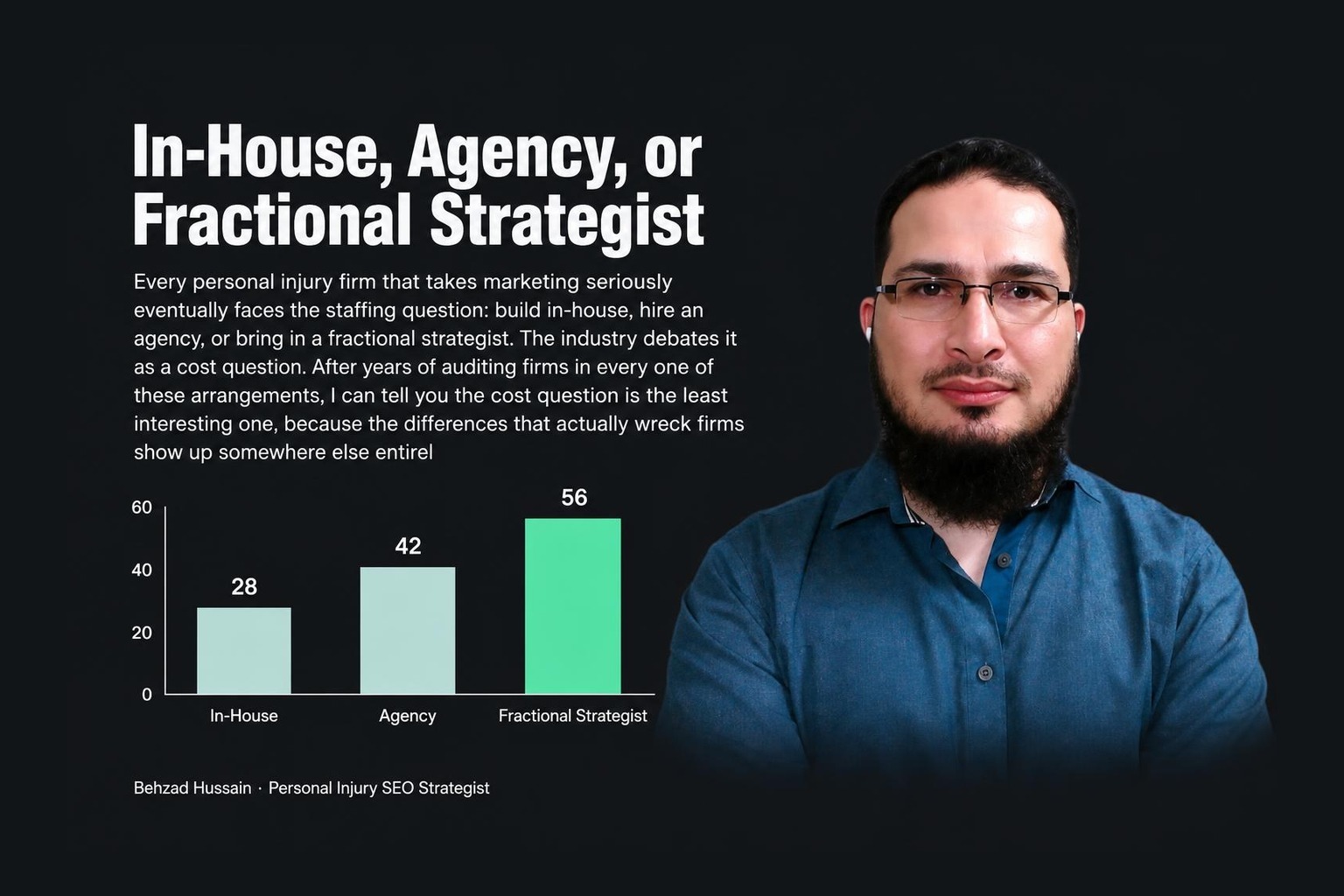
Every personal injury firm that takes marketing seriously eventually faces the staffing question: build in-house, hire an agency, or bring in a fractional strategist. The industry debates it as a cost question. After years of auditing firms in every one of these arrangements, I can tell you the cost question is the least interesting one, because the differences that actually wreck firms show up somewhere else entirely: in WHO OWNS WHAT when the arrangement ends. And every arrangement ends.
So this piece compares the three models on the axis the sales conversations skip: ownership, knowledge, incentives, and what is left standing on the day you part ways.
The asset ledger: the part to read twice
Before comparing models, list what a marketing operation actually accumulates, because each item on this ledger has an owner, and the owner is decided by contracts and account settings, not by who paid for the work.
The domain. Whoever controls the registrar account controls the firm's entire web existence. I have audited firms whose domain was registered by a vendor, in the vendor's account, years ago, by someone who no longer works there.
The website and its content. Under work-for-hire norms the paying client should own the copy, the code, and the design, but plenty of agency contracts quietly license rather than assign, and proprietary platforms make the question moot: if your site lives on a vendor's closed system, you own a database export at best.
The Google Business Profile. GBP has explicit ownership roles, primary owner, owner, manager, and the firm should hold primary ownership with vendors as managers. In audits I keep finding the inverse: the vendor is primary owner, the firm is a manager on its own profile, and nobody remembers the login.
Analytics and Search Console. Same structure: the firm should own the properties, vendors should hold access. When the history lives in a vendor's account, firing the vendor deletes your memory.
The rankings themselves. Here is the one asset nobody can take with them, and the industry pretends otherwise in both directions. Search authority binds to the DOMAIN and the ENTITY, not to the vendor who built it; a good agency's work keeps compounding for you after they leave. But the inverse is equally true: an agency "takes" nothing when you leave, so any contract or platform designed so that leaving destroys your presence is not protecting their work, it is holding your assets hostage.
Every model below gets scored against this ledger.
In-house: maximum ownership, minimum perspective
The in-house hire owns the ledger by default: everything accrues in firm accounts, the knowledge lives down the hall, and the incentive alignment is as clean as it gets, one employer, one agenda.
The structural weaknesses are just as fixed. One person cannot be senior at content, technical, local, digital PR, and analytics at once, so the in-house marketer is a generalist by necessity, and in a vertical this adversarial, generalist depth loses to specialist depth. Worse, the in-house marketer sees ONE market: your firm's. They have no cross-market pattern library, no way to know whether a traffic drop is your problem or everyone's, and their growth depends on conferences and courses rather than daily contact with other markets. And there is a quiet fragility: when that one person leaves, the entire operating memory walks out with them unless the firm enforced documentation nobody enforces.
In-house fits firms big enough to hire several specialists, or firms pairing one inside operator with outside depth. A solo in-house generalist against the top of a major PI market is structurally outgunned, through no fault of their own; the market's leaders are fielding teams against their one chair.
Agency: maximum machinery, diluted attention
A good agency brings what no single hire can: a bench of specialists, tooling, production capacity, and a cross-client pattern library. For execution volume, nothing else competes.
The structural problems are not about talent, they are about geometry. You are one row in a portfolio, and the senior people who sold you rotate off to the next pitch while your account lands with whoever has capacity. Incentives optimize for retention and reportable activity, which is why agency decks overflow with rankings and deliverables and so rarely contain the sentence "we recommend doing less of what you pay us for." Playbooks get amortized across clients, which is efficient and also means your market rarely gets a from-scratch thought. And the ownership ledger is where agencies range from honest to predatory: assignment versus license on content, firm-owned versus agency-owned profiles and properties, portable sites versus proprietary platforms. The contract, not the sales call, tells you which you are getting, and in this vertical a further check matters: some shops serve several firms in the same market, which in a winner-take-most SERP is a conflict no deck will volunteer.
Agencies fit firms that need production scale and have someone, inside or fractional, senior enough to direct it and audit it. An agency with no informed counterparty grades its own homework indefinitely.
Fractional strategist: maximum alignment, no hands
The fractional model, a senior specialist embedded part-time across a small number of non-competing clients, exists to combine the agency's cross-market depth with something close to in-house alignment. Everything accrues in firm-owned accounts, strategy is bespoke because the client count is too small to amortize playbooks, and the economics let a firm rent a level of seniority it could never justify as a full-time salary.
The honest limits: a strategist is not a production department, so execution still needs hands, in-house, contractors, or an agency under direction. Capacity is genuinely finite, a fractional operator who cannot tell you their client ceiling is an agency with better branding. And the model is only as good as the specific human, there is no bench behind them.
I work this way, so weight my view accordingly, and check the claims against the ledger rather than taking them: whether the accounts sit in your name, whether the strategy documents are yours, whether the exclusivity is in writing.
The decision, asked properly
Stop asking "which model is best." Ask three questions in order.
Who owns the ledger? Under any model you choose, the domain, site, content, GBP, and analytics sit in firm-held accounts with vendors as access-holders, or you walk. This is non-negotiable in all three models and violated constantly in one of them.
Who holds the thinking? Somebody senior must own the strategy and be accountable only to the firm. That can be a strong in-house lead or a fractional strategist; it cannot be the same party that profits from executing the strategy, because then the plan always, mysteriously, requires more of what the planner sells.
Who does the work? Production can live anywhere, inside, agency, contractors, once the first two questions are settled. Most mid-market PI firms land on a hybrid: firm-owned everything, one senior strategist, execution bought where it is cheapest to buy well.
One more practical layer, because every arrangement ends: the transition protocol. The time to design the exit is at signing, not at divorce. Into every vendor agreement, whichever model you choose, write four things. A full export clause: site files, content, and data delivered in open formats within a fixed number of days of termination, at no additional condition. An access inventory: a living document listing every account the engagement touches and who holds which role in it, reviewed quarterly, because the inventory that exists only in the vendor's head is the one you will need on the worst possible day. A handover period: a defined number of hours of transition support, so the departing party's knowledge does not leave in a single afternoon. And a non-interference line: no deletion, no deindexing, no "cleanup" of work product on the way out. None of this is adversarial; a vendor confident in their work signs it without flinching, and the ones who negotiate hard against an exit clause are telling you, in advance, exactly how the exit will go.
The firms that get burned are never burned by the model. They are burned by the ledger: they discover, during the divorce, that the marriage owned the house. Run the ownership audit this month, while nothing is on fire: registrar account, GBP primary owner, analytics property owner, contract's IP clause, platform portability. One afternoon, five checks, and the answer to the only question that matters in every vendor relationship, which is what, exactly, is left when it ends.
And whichever model you choose, revisit the choice annually, because the right answer moves with the firm. The two-attorney practice that correctly hired a fractional strategist becomes the forty-person firm that should build an internal team; the firm that outgrew its agency keeps paying it out of habit. The ledger review and the model review belong in the same yearly meeting, one hour, with the contracts on the table, and most firms have never held it once.
The full guide library is at behzadhussain.me and the research behind my audit practice is free at behzadhussain.me